Play Video Games, Get Better Scores In Math!

June 17, 2008 | Posted by sharker in General, News, Psychology


Aha! Now wouldn’t kids love to read that headline! I know that we have heard about the benefits that video games can bring to our kids but of course, many parents and even educators have had their own share of doubts. This is even truer when it comes to video games that have, let us say, controversial content. But let’s not focus solely on the controversial. That does not always result in productive discussion.

Anyhow, a group of researchers from the University of Central Florida conducted a study on educational video games and their effects, specifically, on the math scores of the subjects. Take note that the video games used in the study are labeled educational.

So what did they find out? Students who played the game (DimensionM – pity I have not even heard of this game) over a period of 18 weeks showed considerable improvement in their math scores as compared to those students who did not play the game. The report from the Orlando Business Journal notes:

The results support previous studies which have found that interactive games are more effective on cognitive gains than traditional classroom instruction alone, says Ntiedo Etuk, CEO and co-founder of Tabula Digita, an educational video game company whose DimensionM game series was used in the study.

Again, I think it does not take a rocket scientist to figure this out BUT having solid scientific proof is always a good thing, isn’t it?

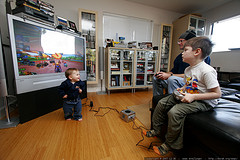
Photo courtesy of Kimblahg

Video Games – Politics Tool?

June 8, 2008 | Posted by sharker in News, Psychology

oconnor
I thought I’ve heard every possible use there is for video games – until I read about Former U.S. Supreme Court Justice Sandra Day O’Connor’s recent speech. Based on what I have read online, the former Supreme Court Justice thinks that video games can get the youth interested in politics – with the ultimate aim of initiating change.

MTV’s Multiplayer blog says:

While O’Connor will probably never play “Halo,” she explained that she came into the digital world after noticing how increasingly difficult it is to receive impartial judgments from serving judges who face mounting political pressure and partisan attacks. She feels that the only way to combat this is with video games about civics education. Yes, that’s right: video games.

O’Connor is spearheading a joint venture with Georgetown Law School and Arizona State University called “Our Courts,” an online civics education project aimed at 7th, 8th and 9th grade students. The free website will allow young people to step into the shoes of a judge, legislator or executive and debate and analyze governmental problems and issues.

The “Our Courts” website is up now, but O’Connor said she hopes that by September it will have the curriculum for classroom use. Gee’s interactive contributions are slated for September 2009.

What can I say? This sounds like a good thing. What do you think? Is this indeed a good move or is it another gimmick that does not really mean anything?

Video Games And Schooling

June 3, 2008 | Posted by sharker in General, News, Nintendo, Psychology, Wii

toddlers video game
I came across a short article by Christopher Dawson over at ZDNet posing the question “Do game consoles have a place in primary education?” His rationale is as follows:

However, the new game, Cosmic Family, is a slick game filled with puzzles and animation. While the puzzles are engaging, the Wii itself, with it’s motion-sensitive Wiimotes, takes a remarkable amount of coordination and sensitivity to operate.

As I watch the kindergarten teacher work to develop just this sort of skill, I have to wonder if there might not be a place for systems like the Wii (with a limited selection of appropriate software, of course) in early elementary education, just as there is for desktop or laptop computers.

It seems to me that the Wii could be a great tool for developmental work, as well as occupational or physical therapy for particular students with identified needs in these areas. The parent in me feels a knee-jerk sense of horror at the thought of Nintendos in classrooms or gymnasiums. However, the technologist in me sees some new tools that just might take us beyond technology for the sake of technology.

I understand how a parent can feel that sense of “horror” at the thought of video games in school. But then again, it really depends on your perspective. If you see video games as a tool to enhance your children’s educational experience, it would probably be a sense of elation and not horror that you would feel.

I think the bottom line here is control and discipline. Just like any other school subject, the idea of using video games for educational purposes should be monitored and guided strictly. I think that it is a perfectly good idea to expose young children to technology - learning and fun together, don’t you think so?

How Long Can You Go Without Gaming?

May 31, 2008 | Posted by sharker in General, Playstation 3, Psychology

I went on a vacation a couple of weeks ago and though I was very excited about the prospect of being at the beach for a week, I was having mixed feelings at the same time. This was due to the fact that I had just received my copy of GTA IV a couple of days before we were set to leave for the beach. I did have a chance to play – believe me, I took every chance I could get – but that was not enough to whet my appetite. I was mulling over the possibilities and came up with three:


-Postpone the trip.
-Take my PS3 with me.
-Forget about gaming for a while.

The second option was very very tempting. Until I realized that I had to take a ferry boat to the island and I didn’t really want to risk damaging the console. So option 3 it had to be.

It was not that bad, really. During the first day, I would think about gaming every now and then and wish fervently that I was at home in front of the TV. Those moments became rarer and rarer until they were totally gone by the 3rd day. However, when the 5th day came around, I was itching to play so badly I just couldn’t wait for the ferry boat to arrive.

So I guess that’s my figure – 5 days without gaming. I survived – and no scars to show for it. How about you, how long can you go without gaming?

When Kids Play GTA

May 20, 2008 | Posted by sharker in Casual Games, Gameboy, General, Playstation 3, Psychology

boys playing GTA
We had two boys aged 7 and 12 – I never knew how creative you had to be in order to keep little boys occupied for 2 days! Anyway, it was kind of a good thing that we have several toys – gaming consoles and computers, that is – that the boys loved.

There were moments of uncertainty for me, however. I had not finished GTA IV then (yes, I have finished it now – I finished it yesterday, to be exact!) and really wanted to play. I tried to avoid it but just couldn’t. So it was not really surprising that after watching me play for a while, the boys were clamoring to be able to play.

GTA IV for kids? I don’t think so! It is not only about the violence and sexually explicit content, really. Following the dialogue and completing the missions are quite complicated activities in themselves. But I gave in – ok, boys, each of you can play for 30 minutes and then go back to the GameBoy or the PC.

Boy, did they have fun! At first they had difficulty controlling the cars. After a while, they were able to do a decent job out of it. Of course, they didn’t really follow the storyline. All they wanted to do was to drive around, get nice cars, and shoot people.

So should kids play GTA? I think that it’s not all that bad. You just have to explain to them the difference between reality and the game. And I really didn’t even have to explain that much – they themselves stated the difference. The only thing I am slightly worried about is that they might become desensitized to violence.

Tell Me What Your Video Games Are…

May 4, 2008 | Posted by sharker in General, Psychology

boys video games
…and I’ll tell you who you are. Obviously, this is my own version of the cliché “tell me who your friends are and I’ll you who you are.” Though I believe that this cliché can be true to some extent, I am not quite sure that it applies to video games.

I am actually not the first person to think along these lines. In fact, I got the idea from Crispin Boyer who wrote an entry in his blog entitled “Do we play what we are?” He, in turn, got his inspiration from a series of essays “Are we what we play?”

It seems that more and more gamers are digging deeper into the psychology of gaming – and why not? Gaming holds more meaning than merely mashing buttons or clicking the mouse.

So, do video games reflect one’s personality? Perhaps. Our choices, when it comes to video gaming, have something to do with our interests in real life. The person who loves basketball spends time playing NBA Live. The person who loves football plays Madden. Does this mean, however, that the person who is crazy about GTA is a killer and a violent person?

I suppose it is not as clear cut as that. I have a friend who has never tried skateboarding. Yet he is addicted to Skate. Then there is another friend who has never laid a hand on any other person and is opposed to violence in principle – yet he can’t get enough of God of War.

So what’s the deal? What do you think?

Video Games: Possible Tension Reliever

May 1, 2008 | Posted by sharker in General, News, Psychology

children playing video games
Another study gives much needed support to video games. According to Carmen Russoniello, a professor at East Carolina University, video games are potentially beneficial when it comes to relieving stress and tension. Here is more information from IT World Canada:

Carmen Russoniello, a professor at East Carolina University, recently finished a six-month study of people playing Bejeweled 2, Peggle and Bookworm adventures. The study concluded the games could have “potential therapeutic applications,” according to a press release issued by PopCap games, which by sheer coincidence happens to be the developer of these three games.

The school’s department of recreational and leisure studies observed the behaviour of video game players and measured their stress, psychological tension, anger, depression, vigour, fatigue and confusion. For example, people who played Peggle experienced a 66 per cent reduction in “psychological tension” while 43 per cent of those who played Bookworm Adventures experienced a reduction in depression. Rumour has it people who reached the fourth screen in Space Invaders also experienced confusion, though that game was not included in Russoniello’s study.

It is interesting to note, however, that only specific games were covered by the study. The GTA series, which could be the most popular game franchise ever, was not included in the study.

The East Carolina University study did not include Grand Theft Auto, a game where players can pretend to be criminals taking on rival gang members and robbing banks. The game’s developer, Rock Star North, also makes Bully and Manhunt.

Oh well, it is a start, isn’t it?